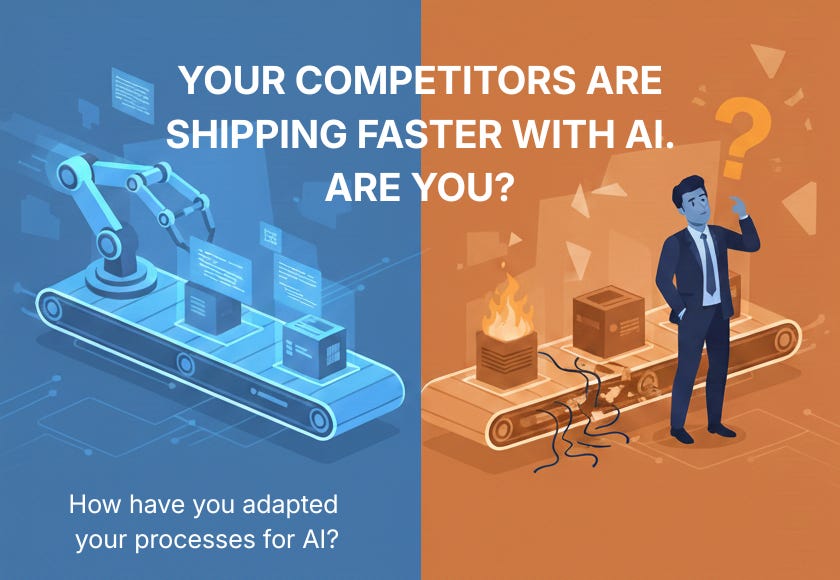
Your Competitors Are Shipping Faster With AI. Are You?
What I've learned helping engineering teams actually capture AI's potential

Here’s what I’ve been seeing with engineering teams lately.
AI coding tools are everywhere now. Cursor, Claude... your developers are probably using them already. And the thing is, they actually work. I’m talking 30-40% faster at the individual level. That’s real.
I wrote before about how I got 90% of my engineers using AI daily. Getting adoption was step one. But here’s what I’ve learned since: adoption isn’t the same as results.
Most teams I talk to aren’t shipping faster. They’re generating more code, sure. But their roadmap? Still stuck. Customers still waiting for features. What’s going on?
The Bottleneck Moved
I would say this is the biggest insight I’ve had working with teams adopting AI: the constraint isn’t where it used to be.
Before AI, the constraint was writing code. Developers spent most of their time implementing stuff.
After AI? The constraint is everything else. Code review queues back up. QA gets overwhelmed. And here’s the kicker... developers spend more time debugging AI-generated code than they saved generating it.
It’s like giving everyone faster cars but keeping the same narrow highway. You just get bigger traffic jams.
The teams actually shipping faster? They’ve widened the highway.
What the Winning Teams Do
I’ve been studying this obsessively. And there’s a clear pattern.
They Front-Load the Thinking
The best teams have figured out something powerful: AI is exceptional at implementation when you give it clear specs.
Think about it. AI is like having an incredibly fast developer who needs precise direction. Vague tickets produce vague results. But detailed specifications with clear acceptance criteria? That’s where AI shines.
So the winning teams flipped the model. They spend way more time on specs, way less on implementation. The spec becomes the product. Code is just the output.
I’ve seen teams cut their cycle time in half doing this. Not because AI wrote code faster... but because they stopped building the wrong thing.
They’ve Redesigned Review
When AI generates code 5-10x faster, your review process becomes the bottleneck. Smart teams adapted:
Tiered reviews: auto-approve low-risk changes, focus human attention where it matters
AI-assisted scanning: use AI to catch issues before human reviewers see the code
Smaller chunks: break work into pieces that flow through quickly
Without this? Your senior engineers drown in review queues. I’ve seen it happen.
They Track Different Metrics
Story points are kind of meaningless now. One team completed 150+ points in a sprint after adopting AI tools. But customers didn’t see features any faster.
What actually matters:
Cycle time: from starting work to customers seeing it
Lead time: from request to production
Deployment frequency: how often you’re shipping
These tell you if AI investment is translating to customer value. And you don’t need to understand the technical details to track them.
The Questions I’d Ask
If I was a non-technical founder looking at my engineering team right now, here’s what I’d want to know:
“What’s our cycle time?” If they can’t answer clearly, that’s a red flag. Teams capturing AI’s value know this number. And it’s going down.
“How have we adapted our processes for AI?” The right answer involves specific changes. Not “we installed Copilot.”
“What specs exist before developers start building?” If the answer is just Jira tickets... you’re probably getting inconsistent output.
“What’s our deployment frequency compared to six months ago?” If AI is working, this should be going up.
You don’t need to understand the technical details. You need to ask better questions.
Why This Matters Now
Here’s the thing. AI coding tools are still early. Most companies are experimenting, not optimizing.
The founders who figure this out first, who build engineering organizations designed to amplify AI... they’ll compound that advantage. Ship faster today means more customer feedback, more iterations, more product-market fit.
Your competitors are adopting AI. The question is whether you’ll capture its potential faster than they do.
What I Help With
Unlocking AI’s full potential isn’t a tools problem. It’s an organizational design problem.
Process architecture that puts AI in the right place
Metrics that connect engineering to business outcomes
Team development that builds AI fluency
Strategic oversight so AI investment actually translates to shipping faster
This is what I do as a fractional CTO. Not adding headcount. Unlocking the team you already have.
If you’re a non-technical founder and some of these questions made you uncomfortable... let’s talk.
I offer a free 30-minute call for non-technical founders who want to figure out where they stand. No pitch, just an honest look at your setup.